Explore by topic

Rathaus Korbach: An Urban Mining Concept Based on Selective Demolition
Last updated: Jan 29, 2025
Summary
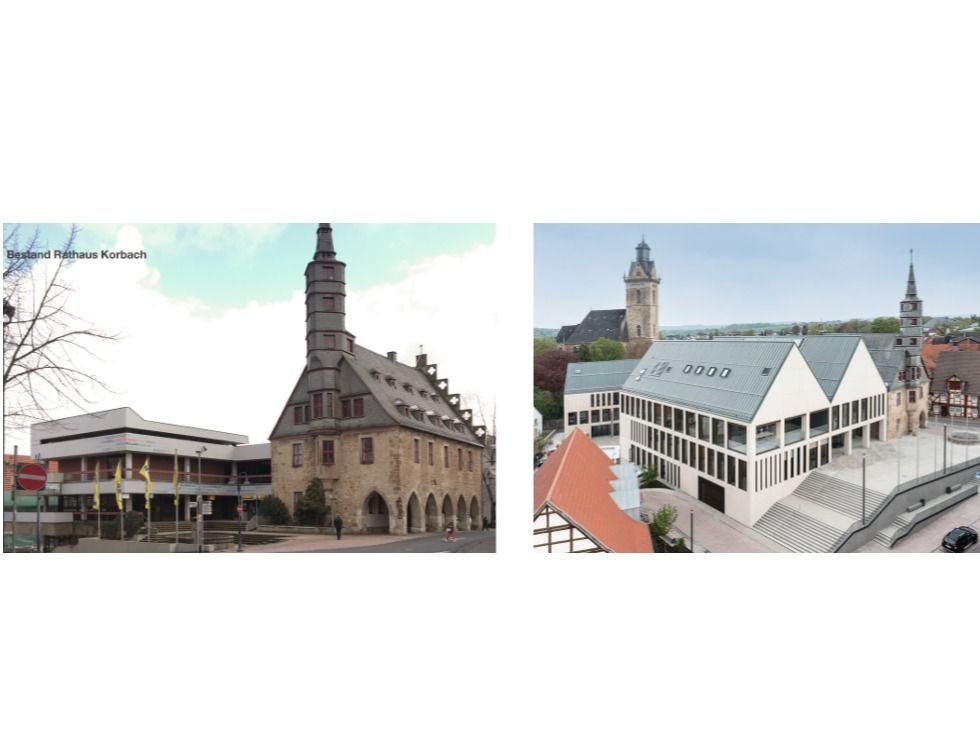
The Rathaus Korbach project deconstructed a 1970s Town Hall extension to create a new, sustainably designed municipal building. By prioritising selective demolition, local recycling, and the reuse of materials, the project achieved a circular construction model.
Problem
The existing 1970s Town Hall extension was deemed unsuitable for renovation, requiring its replacement. Despite this meticulous planning, issues arose during the implementation phase, particularly with the bonding materials in the original structure. As a result, the quality of the recycled materials that could be recovered was limited, which reduced the availability of high-quality aggregates for the new building’s concrete.
Solution
Regardless of this setback, the project successfully benefited from local recycling and reuse.
Approximately 5,400 tonnes of concrete from the ceilings, beams, and columns of the existing 1970s building were recycled, with up to 50% of this material processed as recycled stone aggregates to reinforce the supporting structure of the new building. Additionally, around 23 tonnes of brick fragments were integrated into the facade, while finer particles from the demolition were used to fill the construction pit on-site. This method reduced the need for new materials while retaining the value of existing resources.
The new building was also designed to serve as a future material bank, with features that facilitate easy disassembly and recycling. For example, the new roof features a zinc covering paired with detachable insulation made predominantly from secondary raw materials, including glass wool and foam glass.
This project, initiated by the city of Korbach, prioritised local recycling facilities, which played a key role in reducing transportation and disposal costs while supporting the regional economy.
Outcome
The Ministry’s primary goal was to showcase the feasibility of circular construction practices, specifically in the context of selective demolition and local recycling of building materials. The framework proved that building with recycled and reused materials is feasible and replicable.
Besides, the project highlighted the need for improved material processing technologies to address bonding issues in future projects, shedding light on both the complexities and the potential of circular construction.
The regional authorities recognised the Korbach Town Hall project as a blueprint for circular construction. It offers practical guidelines for resource-saving building practices that align with the sustainable urban development standards in the Hesse region.
Industries
Involved organisation(s)
Key elements of the circular economy
Attachments and links
Contributors
Owner
Date added: Jan 28, 2025
Last updated: Jan 29, 2025
More from the contributors


Add your content
Strengthen the circular economy knowledge base by adding a report, case study, publication, or other resource to our platform!