Explore by topic

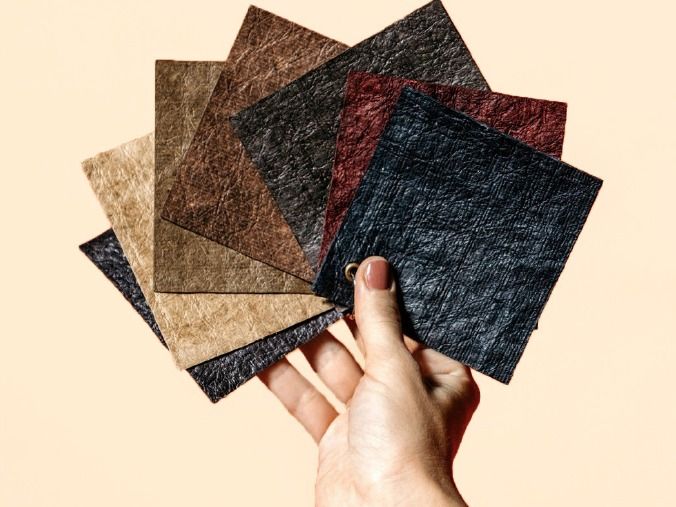
Malai: A leather-like material grown from coconut wastewater
Last updated: Apr 11, 2023
Summary
Malai is a bacterial cellulose-based bio-composite material grown from agricultural waste from the coconut industry in Southern India. The natural polymer synthesised by bacteria is mixed with plant fibres (banana, hemp, sisal) and natural gums to improve its strength properties.
Problem
The leather industry in India accounts for around 13% of the world’s leather production of hides and employs approximately 4 million people. However, the entire life cycle of leather production - from raising cows to skinning and initial tanning to the finishing process - has negative environmental impacts, making the leather industry one of the leading agents of industrial pollution. More than 400 different types of chemicals are used in leather processing, most of which are toxic to the environment such as, formaldehyde, coal-tar derivatives, oils and dyes. Also, leather requires a substantial amount of water and energy to produce.
Solution
Malai is a company based in Kerala, India, focused on the development of circular materials based on coconut wastewater, founded by material designer Zuzana Gombosova, and product designer and mechanical engineer, Susmith Suseelan. Bacterial cellulose is sustainably produced by microorganisms and has attracted industrial interest from the textile sector due to its properties.
Working alongside coconut farmers and processing units to collect their coconut wastewater, the company has efficiently reused this waste. Typically, this waste would be released into the drainage system, causing water pollution and soil acidification. One small coconut processing unit can collect 4000 litres of water per day, which can be used to make 320 sq. metres of Malai.
The material is a PETA-certified alternative to leather, free of any artificial substances making it a sustainable vegan material that can be used to produce fashion goods and home interiors. Malai is a fully compostable material that will biodegrade in compost in 90 - 120 days.
Location
Industries
Involved organisation(s)
Key elements of the circular economy
Attachments and links
Contributors
Owner
Contributor
Contributor
Date added: Aug 11, 2021
Last updated: Apr 11, 2023
More from the contributors









Add your content
Strengthen the circular economy knowledge base by adding a report, case study, publication, or other resource to our platform!