Explore by topic

From Aflaj to oases: Climate-resilient agriculture in Oman
Last updated: Apr 29, 2026
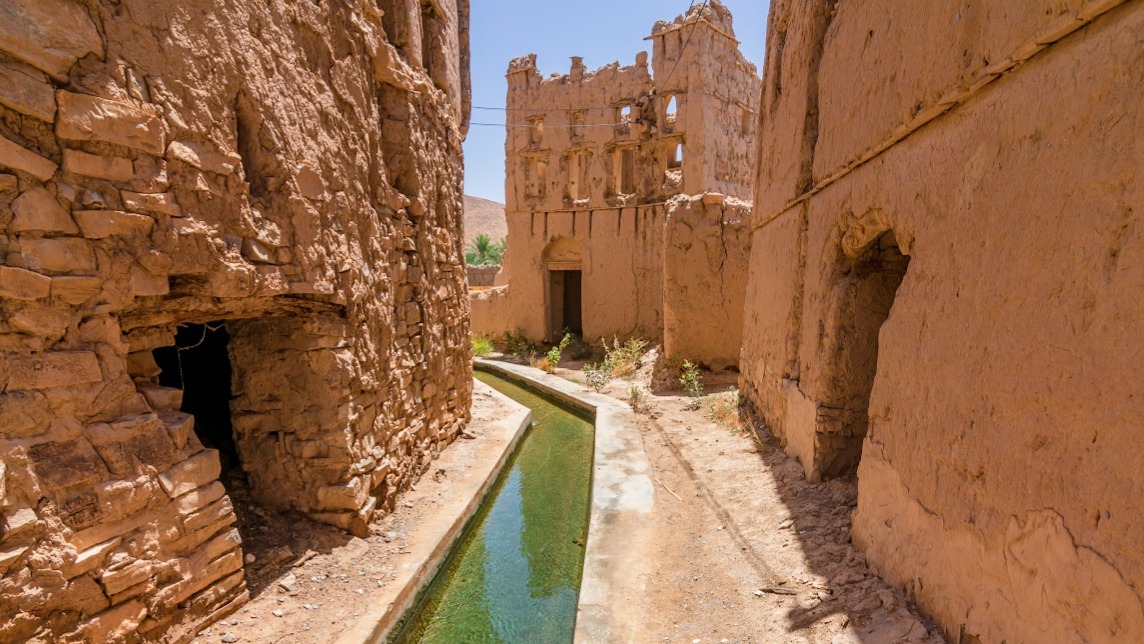
Photo from Photos Aflaj Department - Directorate General Of Water Management - Ministry Of Agriculture, Fisheries Wealth and Water Resources in Oman
Summary
Climate-resilient agricultural practices have been embedded in Oman’s agricultural systems for centuries, shaped by the country’s arid climate and notable water scarcity. Traditional approaches such as terraced cultivation, Aflaj irrigation systems, and oasis-based agriculture with high plant diversity demonstrate long-standing circular principles in land and water management, being built entirely on circular logic of resource efficiency, waste elimination, and regenerative logic.
Problem
In Oman, agriculture is central to the food system and human well-being, but also plays an important role in cultural and religious identity, and national resilience in Oman. While agriculture is not a dominant economic sector, it plays a vital role in food security, heritage, and community life. Oman is food secure but not food self-sufficient, relying heavily on imports for several food products. This dependency is intensified by environmental constraints, particularly limited water availability and arable land.
Oman’s agricultural sector operates under severe natural conditions. Only around 4.6% of the country’s total land area is suitable for cultivation, while approximately 80% of the country is classified as desert or semi-desert. Water scarcity is acute, with many regions receiving less than 100 mm of rainfall annually—far below the requirements for rainfed agriculture. Oman’s topography varies in different parts of the country, presenting unique challenges, for instance, coastal areas face high humidity and heat, increasing crop stress and disease risks, while interior regions experience extreme temperatures and minimal precipitation. Soil salinity, declining groundwater levels, and limited irrigation capacity further constrain agricultural productivity and ecosystem health. Together, these conditions make conventional, resource-intensive agricultural models unsustainable, underscoring the need for circular and regenerative approaches.
Solution
Given these constraints, improving resource efficiency in agriculture is not merely an option but a necessity. Circular and regenerative practices—such as sustainable land use, efficient water management, reduced food waste, and diversified cropping systems—offer pathways to lower resource demand, reduce environmental pressures, and strengthen domestic food production.
Oman already practices proven, locally adapted solutions. The Aflaj irrigation systems, some dating back up to 2,000 years, channel groundwater, spring water, or surface water to agricultural areas through gravity-fed networks. These systems distribute water equitably to terraced fields and oasis farms, supporting soil enrichment and the cultivation of crops such as dates, pomegranates, walnuts, grapes, and vegetables. Oasis agriculture integrates multiple crop layers and relies on collective management and shared responsibility, maximising productivity while minimising water losses. These practices reflect a circular approach to water and land use, sustained through traditional knowledge passed down through generations.
Outcome
These resource-efficient agricultural systems have enabled continuous food production in Oman over centuries, despite extreme climatic conditions. This has led to relative self-sufficiency in fruit and vegetable production, particularly in irrigated regions such as the Batinah Plain and interior agricultural zones, despite broader import dependencies in Oman. In 2024, overall self-sufficiency in agricultural products stood at approximately 49.4%, with higher rates (around 60–70%) for fruits and vegetables. Key domestically produced fruits include dates, mangoes, limes, bananas, and coconuts, while vegetable production includes crops such as tomatoes, cucumbers, aubergines, okra, carrots, onions, and leafy greens. These systems recapture, distribute, and reuse scarce water resources efficiently, enabling food production in one of the world’s most challenging environments for agriculture. They illustrate that circular economy practices are not new to Oman but are deeply rooted in cultural knowledge and community-based resource governance.
This demonstrates how traditional, resource efficient practices coincide with circular practices, and how these continue to support food security, biodiversity, and resilient livelihoods in a water-scarce context, providing valuable lessons for future circular economy strategies for the food system.
Sources include links added and Circle Economy. (2026). The circularity gap report Oman. Amsterdam: Circle Economy.
Location
Industries
Involved organisation(s)
Key elements of the circular economy
Attachments and links
Contributors
Owner
Date added: Apr 29, 2026
Last updated: Apr 29, 2026
More from Circle Economy



Add your content
Strengthen the circular economy knowledge base by adding a report, case study, publication, or other resource to our platform!