Explore by topic
Kinn Bryggeri gives away brewers grain to local farmers and bakeries to be used as nutrition
Last updated: Jan 22, 2025
Summary
Kinn Bryggeri AS is a small brewery in Florø that was established by Espen Lothe in 2009. The beer sales were originally meant to be kept local, but as sales in the brewery's first year were 2000 liters, which increased to 32,000 liters in 2010, and 76,000 liters in 2011, the company is now one of the leading breweries in Norway. Kinn has found a way to save costs by getting rid of one of the bi-products in the brewing process, «mask» (brewers grain), which they instead of paying to get collected by local waste solutions, give away for free for local farmers and bakeries to pick up at their brewery site.
Problem
When the brewery process is complete and the sweet wort has been pumped over to the wort pan, the milk container must be emptied. The used malt is called “mask” and is a grain-based residue from the brewing process. Worldwide, the brewing industry produces about 38.6 million tonnes of “mask”. Usually one has to pay local waste collecting systems to pick up this “mask”, which is costly for the breweries. On the other side of this case, we have farmers, who both use money and resources to feed their stock. The livestock sector consumes annually about 6 billion tonnes of feed material in dry matter, including one third of global cereal production. The land that is used to grow this feed could be maximized in other ways, such as regenerative crops for food for humans.
Solution
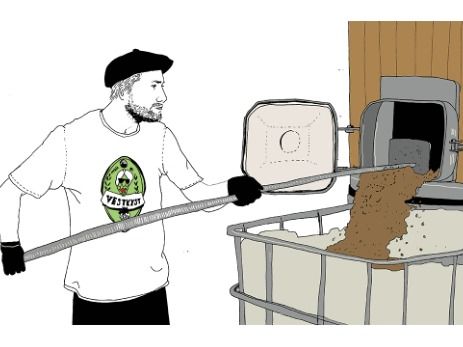
Kinn collects its “mask” during beer production and gives it for free to local farmers. This way both themselves and the farmers save money and time by looking at what previously would have been perceived as waste, as a valuable resource. The farmers use the mask to feed cows and pigs. A small part of the mask also goes to the local bakery. They use the mask in the dough when they bake a tasty bread called Kinn bread.
Outcome
The breweries have long thought of the mask as a residual product without any special value. But in fact, the dairy industry is requesting more mask. This is a feed rich in fiber, and it also has some valuable protein. Mask can to some extent reduce the use of imported soy. Unfortunately, the mask has a short shelf life and contains a large proportion of liquid, which makes it unfavorable to transport and difficult to store, but with the right treatment this can become a valuable resource. With the help of biotechnology, for example through the use of enzymes, we may also be able to get mesh-based feed that can help the cows produce less methane. Currently there is research being made on how the mask can be used in several industries, including as food for humans, for the extraction of chemicals, in pharmacy, in packaging and biofuels.
Location
Industries
Key elements of the circular economy
Contributors
Owner
Date added: Jan 3, 2022
Last updated: Jan 22, 2025
More from the contributors


Add your content
Strengthen the circular economy knowledge base by adding a report, case study, publication, or other resource to our platform!